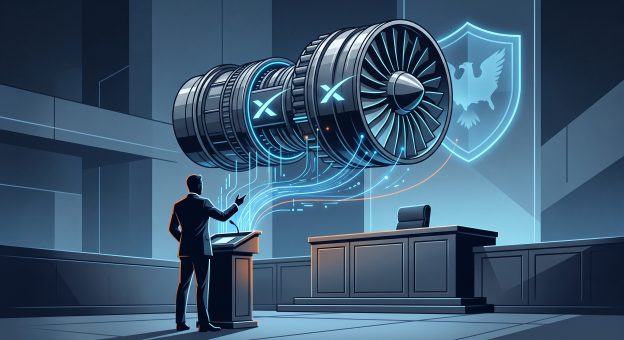
In June 2026, the U.S. Department of Justice asked a federal court to dismiss a Clean Air Act lawsuit against Elon Musk’s xAI, arguing that the gas turbines powering the company’s Colossus supercomputer near Memphis are a matter of national security. It was an extraordinary intervention in what had been a local air-permitting dispute — and it put a national spotlight on a question every data center developer is now wrestling with: how do you legally power a gigawatt-scale facility when the grid can’t connect you for years?
This explainer lays out what happened, how the “temporary turbine” loophole worked, why the EPA closed it, what the DOJ’s national-security argument actually says, and — most useful for developers and investors — how long it really takes to permit and build new gas generation today.
The short version
- xAI used trailer-mounted gas turbines to power its Memphis-area data center, classifying them as “temporary” equipment to avoid standard Clean Air Act permitting.
- The NAACP, represented by the Southern Environmental Law Center and Earthjustice, sued in April 2026, alleging the turbines were running without required federal air permits.
- The EPA had already closed the “nonroad engine” loophole in mid-January 2026, ruling that turbines used for primary power at a fixed site need Clean Air Act permits.
- On June 16, 2026, the DOJ moved to intervene and dismiss the case, arguing that xAI’s Grok model is critical to U.S. military operations and that shutting off its power threatens national security.
- A federal judge in Mississippi is scheduled to weigh the request for a preliminary injunction in late August 2026.
What is the xAI gas turbine lawsuit about?
xAI powers its Colossus and Colossus 2 supercomputers — the clusters that train and run its Grok models — partly with on-site gas turbines located in Southaven, Mississippi, just across the state line from South Memphis, Tennessee. As xAI scaled, the on-site turbine count grew rapidly: from roughly 18 units in mid-2025 to a complaint filed over 27 turbines (rated at about 495 MW), and reportedly to more than 50 units by mid-2026.
The NAACP, represented by the Southern Environmental Law Center (SELC) and Earthjustice, filed suit in April 2026. The core allegation is procedural: that xAI operated the turbines without the air permits the federal Clean Air Act requires, in a region that already faces elevated ozone and nitrogen-oxide (NOx) levels. xAI and the state of Mississippi argued the trailer-mounted units qualified as mobile or temporary sources exempt from stationary-source permitting. The plaintiffs requested a preliminary injunction to halt continued operation.
What is the “temporary turbine” loophole?
The mechanism at the center of the case is the nonroad engine exemption — sometimes called the “364-day rule.” Under this interpretation, equipment that is mounted on trailers and not expected to stay in one location for more than 364 days could be treated as a temporary, mobile source rather than a permanent power plant, sidestepping the standard Clean Air Act permitting process (including public comment and emissions review).
That classification is what allowed xAI to move fast. Using portable turbines, the company reportedly stood up roughly 100,000 GPUs in about 19 days while permanent grid infrastructure was still being built — a timeline Nvidia CEO Jensen Huang has said normally takes around four years. Other developers took note: behind-the-meter and mobile gas generation became a common bridge strategy for data centers facing multi-year waits for grid power.
What did the EPA rule in January 2026?
In mid-January 2026, the EPA updated its interpretation of the Clean Air Act, clarifying that gas turbines used for primary power generation at a fixed facility cannot be classified as nonroad engines, regardless of whether they are mounted on trailers. Companies must obtain Clean Air Act permits before installing and operating such turbines, particularly where combined emissions exceed major-source thresholds.
In practical terms, the ruling closed the loophole nationwide and moved oversight of these installations to the federal level. It applies to every developer that had been using temporary or modular gas turbines as a fast bridge to power, not just xAI.
Why did the DOJ intervene? The national security argument
On June 16, 2026, the DOJ’s Environment and Natural Resources Division moved to intervene in the case and asked the court to dismiss it. Notably, the filing did not dispute that the turbines lack the required permits. Instead, it argued that the national, economic, and energy-security stakes outweigh the enforcement claim.
The Department of Defense supported the filing with a declaration stating that xAI’s Grok is one of only four frontier AI models cleared to support mission-critical operations on classified networks, and that interrupting the data center’s power would threaten ongoing national-security work. Because the EPA had already ruled the turbines require permits, the DOJ’s position effectively places one federal agency’s argument against another’s — a wrinkle the court will have to navigate. A hearing on the preliminary injunction is set for late August 2026.
How long does it actually take to permit and build a gas power plant?
This is the question underneath the entire dispute, and it is where the case matters most for developers and investors. The reason companies reach for temporary turbines is that the conventional path to new dispatchable power has stretched to a length that does not fit the AI buildout’s timelines.
A few reference points from current industry data:
- Turbine lead times: Large heavy-frame gas turbines ordered today generally won’t deliver until around 2031. Combined-cycle units now carry roughly five-to-seven-year lead times, and the major manufacturers (GE Vernova, Siemens Energy, Mitsubishi) are largely booked into 2028–2029.
- Cost: EPRI research found average gas turbine prices rising from roughly $2,000/kW to about $3,000/kW in a span of six months.
- Demand: U.S. gas turbine orders reached roughly 14 GW in 2024 — the highest level since 2001, the peak of the last great gas build.
- Interconnection: The timeline from interconnection request to commercial operation now commonly runs four to five years for most generation types.
- Permitting: Obtaining major-source air permits can add roughly 12–18 months on its own.
Stack these together and a greenfield gas plant ordered today realistically reaches commercial operation around 2032–2033. By contrast, during the early-2000s gas build, a developer could order a turbine and have a plant running in roughly two years. The appetite to build hasn’t shrunk; the time required to do it has multiplied.
What is Texas SB6 and the large-load interconnection process?
Texas has moved faster than most jurisdictions to create a defined path for large electricity users. Senate Bill 6 (SB6), signed by Governor Greg Abbott in June 2025, established the first comprehensive large-load interconnection framework in the country, covering loads of 75 MW or more on the ERCOT grid.
SB6 directs the Public Utility Commission of Texas to set interconnection standards, study fees, site-control requirements, and emergency curtailment rules for large loads such as data centers. The goal is to bring big new users online in an orderly way while protecting grid reliability. The demand it is responding to is enormous: ERCOT’s large-load interconnection queue grew from roughly 63 GW in December 2024 to more than 200 GW a year later, with data centers making up the large majority.
What this means for data center developers
The xAI case crystallizes a set of decisions now facing anyone trying to power AI infrastructure:
- Bridge power is now a federal-permitting question. With the nonroad-engine loophole closed, temporary and behind-the-meter gas turbines used for primary power require Clean Air Act permits. The fast-energization playbook still works, but the compliance path runs through federal review.
- Permitting and lead times are financing variables, not footnotes. When equipment and interconnection timelines run five to eight years, the schedule risk shows up directly in a project’s financeability.
- Jurisdiction is a strategic choice. States with defined, faster large-load processes — Texas being the clearest example — are pulling capital and projects toward them.
- Emissions controls are part of the timeline calculus. Selective catalytic reduction (SCR) and oxidation catalysts are mature technologies that sharply reduce NOx and CO, but installing them is part of what proper permitting requires and times.
These are the questions on the table. What a developer, investor, or buyer should actually do about them — and what the DOJ’s national-security move signals for the wider buildout — is the subject of this week’s Power Signal analysis.
Read the analysis: Power Signal’s breakdown, “Regulate This,” goes past the headlines to the operator’s verdict — why both the loophole and the national-security filing became necessary in the first place, and what it means for where to build next. Read it on Power Signal →
Frequently asked questions
Who is suing xAI over its gas turbines? The NAACP, represented by the Southern Environmental Law Center and Earthjustice, filed the Clean Air Act suit in April 2026, alleging xAI operated gas turbines near Memphis without required federal air permits.
What is the “temporary turbine” or nonroad engine loophole? It was an interpretation that allowed trailer-mounted turbines not kept in one place for more than 364 days to be treated as temporary mobile sources, exempt from standard Clean Air Act permitting. The EPA closed it in January 2026.
Did the DOJ say xAI’s turbines are legal? No. The DOJ’s June 2026 filing did not dispute that the turbines lack permits. It argued that national-security interests outweigh the enforcement claim and asked the court to dismiss the case.
How long does it take to build a new gas power plant in 2026? With turbine lead times of five to seven years, interconnection waits of four to five years, and permitting on top, a greenfield gas plant ordered today realistically comes online around 2032–2033 — versus roughly two years during the early-2000s gas boom.
What is Texas SB6? A 2025 Texas law that created the first comprehensive framework for interconnecting large electricity loads (75 MW and above) on the ERCOT grid, setting standards for study fees, site control, and emergency curtailment.
Why are data centers using gas turbines instead of the grid? Because grid interconnection now takes years, while on-site gas turbines can bring power online in months — a gap that has made behind-the-meter generation a common bridge strategy for AI infrastructure.
Energy.Media covers the facts shaping power generation, data centers, and AI infrastructure. For weekly operator analysis of what it means and what to do about it, subscribe to Power Signal.