Executive Summary
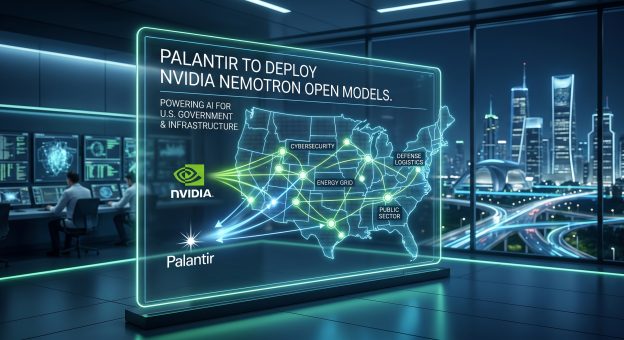
Palantir Technologies and NVIDIA have launched a strategic initiative to deliver an intelligent engine for running NVIDIA AI and Nemotron open models in sovereign environments, targeting U.S. government agencies and critical infrastructure operators. The joint offering combines Palantir’s AIP, Ontology, Foundry, and Apollo platforms with NVIDIA’s AI compute and open-source Nemotron models, enabling customers to retain full control over their data, intellectual property, and AI systems—with explicit authorization, secure perimeter enforcement, and full auditability. The engine includes a feedback loop for continuous model improvement based on mission-specific data and user telemetry.
The Players
Palantir Technologies is the defense and enterprise data analytics giant, known for its Foundry and AIP (Artificial Intelligence Platform) software. It has deep relationships with U.S. intelligence, military, and critical infrastructure sectors, making it the logical partner for sovereign AI deployments.
NVIDIA is the global leader in AI compute, but this initiative emphasizes its open-source Nemotron models—not its proprietary GPUs. The partnership is about software and model sovereignty, not hardware sales, though NVIDIA’s broader AI platform (including NIM microservices) underpins the offering.
The target customers are explicitly U.S. government agencies (classified, air-gapped, and sensitive environments) and U.S. critical infrastructure (energy, finance, transportation). Unlike other AI deployments where data leaves the customer’s control, this offering is designed for environments where data sovereignty is non-negotiable.
The Numbers
No financial terms are disclosed—this is a strategic product launch, not an acquisition or financing. However, context is critical:
-
Palantir’s stock (PLTR) is highly sensitive to government contract wins.
-
NVIDIA’s Nemotron models are positioned as the open-source alternative to OpenAI’s proprietary models, directly competing with Anthropic (Claude) and Google (Gemini) for government customers.
-
The offering is an extension of Palantir’s previously announced Sovereign AI Operating System Reference Architecture with NVIDIA, suggesting this is a go-to-market push rather than a new R&D effort.
The “sovereign environments” market is substantial: U.S. defense AI spending alone is projected to exceed $15 billion annually by 2030, with comparable amounts for intelligence and critical infrastructure.
So What?
This deal validates three critical trends, but from a software/governance perspective rather than hardware/power:
First, open-source AI is now a national security imperative. NVIDIA’s Nemotron models are not just cheaper than closed models—they are essential for sovereign control. Closed models (OpenAI, Anthropic, Google) retain user data and model improvements within their own weights, creating a national security risk. The Palantir/NVIDIA engine allows the U.S. government to “own” its own model improvements, with post-training and alignment based on classified data.
Second, the feedback loop is the new moat. The engine collects user telemetry and trace data, then uses it to continuously improve models. This is the same playbook as consumer AI (ChatGPT, Claude) but applied to classified environments. Agencies that deploy this engine will have self-improving models that become more valuable over time, creating a switching cost that locks them into Palantir/NVIDIA.
Third, AI governance is now a product category. The key capabilities listed—explicit data authorization, secure perimeter enforcement, architecturally-enforced isolation, data portability, right to erasure, and full auditability—are governance features, not AI capabilities. This is the compliance layer that makes AI acceptable in regulated domains. Competitors who cannot match this governance stack will be excluded from sovereign and critical infrastructure markets.
What Should You Do With This?
If you are a U.S. government agency or critical infrastructure operator: this offering solves the “black box” problem of proprietary AI. You can deploy frontier models without surrendering data or control. Your next RFP should specify open-source models with full auditability and on-premises training—Palantir/NVIDIA just set the bar.
If you are an investor: this is a bullish signal for both PLTR and NVDA. Palantir is the go-to partner for sovereign AI deployment, and NVIDIA’s open model strategy is now differentiated from closed competitors. Watch for follow-on contract announcements—the first major agency adoption will be a significant catalyst.
If you are a policymaker: this is the template for national AI strategy. Open-source models, deployed in sovereign environments with full auditability, should be the default for government AI. Mandate this approach in procurement guidelines to avoid vendor lock-in and data leakage. The Palantir/NVIDIA architecture provides a reference implementation for secure, transparent, and self-improving AI systems.
Source: Business Wire, 6/19/2026