Executive Summary
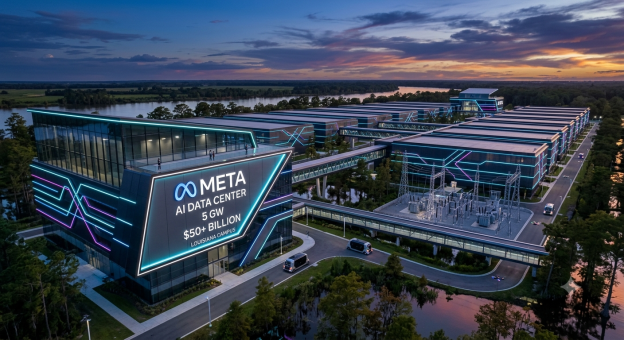
Meta announced a major expansion of its Hyperion AI supercluster in rural Louisiana, increasing planned capacity from previous estimates to 5 gigawatts. The company’s total investment for the project has now surpassed $50 billion.
The Players
Meta is the sole developer and investor. Meta is building this in rural Louisiana, which means new transmission, new generation, and new interconnection challenges at scale. They are currently working with utility Entergy on 7 new natural gas-powered generation plants, three grid-scale batteries, and additional nuclear.
The Numbers
- Capacity: 5 GW of AI data center load
- Total Investment: Over $50 billion
- Infrastructure Commitment: $1 billion+ for local improvements
- Timeline: Not specified, but expansion announced July 13, 2026
To put 5 GW in perspective: that’s equivalent to roughly five large combined-cycle gas plants running at full capacity, or approximately the peak demand of the entire state of Louisiana during moderate load periods. This is not incremental data center growth — this is the creation of a new major load center.
So What?
This announcement has immediate implications for power developers, utilities, and energy investors:
- Generation Gap: 5 GW of new load requires substantial new generation. Even with aggressive energy efficiency, this likely means 6-7 GW of nameplate capacity when accounting for reserve margins and reliability requirements. That’s a pipeline opportunity for dispatchable generation — gas turbines, nuclear, or hybrid solutions.
- Ratepayer Risk: This is why the White House is reportedly preparing pledges to shield ratepayers from data center-related bill hikes. When a single private entity adds load equivalent to a mid-sized state, cost allocation becomes a political issue. Developers should structure deals that clearly isolate hyperscaler costs from residential ratepayers.
- Market Signal: Meta is not alone. This follows similar gigawatt-scale announcements from Microsoft, Google, and Amazon. The hyperscaler build-out is no longer speculative — it’s happening, and it’s happening faster than the grid can adapt.
Source: Multiple reports including Yahoo Finance, Tom’s Hardware, and Channel News Asia, July 13, 2026.