Executive Summary
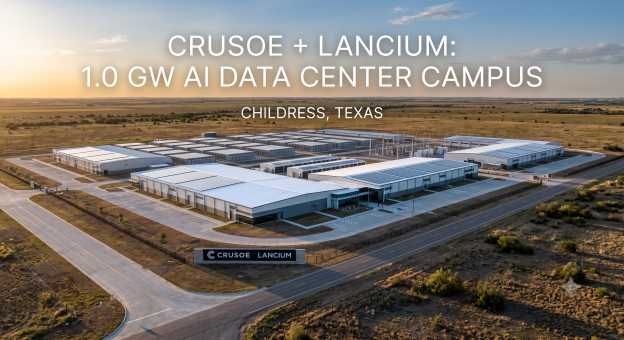
Crusoe, a vertically integrated AI infrastructure provider, and Lancium, an energy technology and infrastructure company, have announced a 1.0 gigawatt (GW) AI data center campus in Childress, Texas, on a 270-acre site owned by Lancium. The grid-connected campus, which will also feature behind-the-meter solar and energy storage, is being developed for a leading hyperscale technology company. Construction is expected to begin in Q3 2026, creating thousands of construction jobs and over 100 long-term positions. This is another partnership between the companies, following a 1.2 GW campus in Abilene where Crusoe energized its first two buildings within one year and a recently announced 900 MW expansion on adjacent land.
The Players
Crusoe is an AI infrastructure provider that describes itself as an “AI factory company.” Unlike traditional colocation providers (Equinix, Digital Realty) or cloud providers (AWS, Google), Crusoe designs, builds, and operates data centers optimized specifically for AI workloads, with a focus on energy integration. Its model is to partner with energy asset owners to secure dedicated power.
Lancium is an energy technology and infrastructure company founded in 2017 and headquartered in The Woodlands, Texas. Its niche is: (1) acquiring land, (2) securing grid interconnections, (3) developing behind-the-meter generation and storage, and (4) managing energy orchestration. It is essentially a power developer that specializes in serving data center campuses. Lancium’s expertise includes using its campuses as grid assets, providing flexibility to the grid operator (ERCOT) while hosting demanding workloads.
So What?
This announcement validates three critical trends, now proven at scale in Texas:
First, Texas is the undisputed AI power capital. Texas has more AI-dedicated power in development than any other state. The combination of ERCOT’s deregulated market, abundant land, favorable permitting, and existing transmission infrastructure makes it a haven for AI compute.
Second, speed-to-power is now measured in months, not years. Crusoe and Lancium energized the first two buildings in Abilene within one year of groundbreaking. This is an order of magnitude faster than typical data center construction (18-24 months) and significantly faster than greenfield power plants (3-5 years). This speed is the result of: (1) pre-secured power interconnections, (2) modular construction, (3) Lancium’s energy orchestration that can manage grid constraints, and (4) Crusoe’s AI-optimized design.
Third, behind-the-meter solar and storage is becoming standard. The Childress campus will include solar and energy storage, adding a renewable component to what is a grid-connected (gas/renewable mix) supply. Storage allows the campus to arbitrage power prices and provide grid services, turning a cost center (electricity) into a potential revenue stream. This model, pioneered by Lancium, is now a competitive differentiator.
What Should You Do With This?
If you are a hyperscaler (AWS, Google, Microsoft, Oracle): the Crusoe/Lancium model is a viable alternative to building your own campuses. You can lease capacity with zero development risk, no land acquisition, and no interconnection delays. Your trade-off is higher operating costs versus lower capital expenditure. Evaluate this partnership model for your next 1 GW block—it could be faster than your internal real estate team.
If you are a utility: these campuses represent both load growth and grid challenges. 1 GW of data center load is the equivalent of a small city. But Lancium’s energy orchestration (including storage and potential curtailment) can make these campuses grid assets rather than grid liabilities. Offer flexible interconnection terms and explore public-private partnerships to accelerate transmission upgrades.
If you are a competitor data center provider: Crusoe is proving that “AI-optimized” design is not just marketing. They are building more dense, more efficient, and faster than traditional colocation providers. Your response must include: (1) adopting modular, AI-specific building designs, (2) partnering with energy companies to secure dedicated power, and (3) offering “power-plus-compute” bundles rather than just white space.
If you are an investor: watch the Crusoe/Lancium partnership as a proxy for the AI infrastructure build-out. They are not public (yet), but their suppliers (construction, power equipment, cooling) and customers (hyperscalers) are. Use their announcements to gauge the pace of real-world AI capacity deployment.
Source: Crusoe/Lancium press release 7/15/2026