Executive Summary
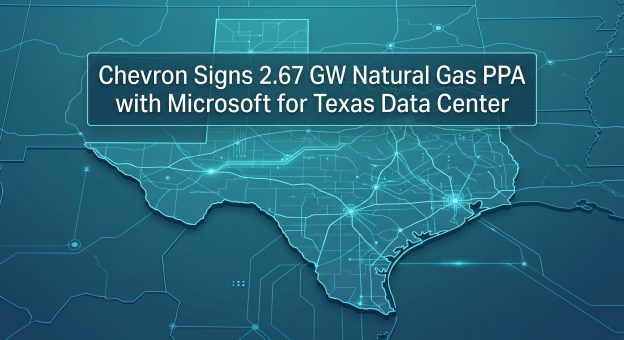
Chevron has signed a 20-year power purchase agreement with Microsoft to supply 2.67 GW of natural gas-fired electricity to a data center in West Texas. This represents a significant entry by an oil major into the dispatchable power generation market for hyperscale computing.
The Players
Chevron New Energies, the energy transition arm of Chevron Corporation, is the power supplier. Microsoft is the offtaker, deploying the capacity for a data center campus in West Texas. The gas facility will be co-located and is known as Project Kilby. The deal bypasses traditional utility structures, with Chevron effectively acting as an independent power producer delivering electricity directly to Microsoft’s facility. Kilby is expected to be among the largest co-located natural gas power projects in the United States.
The West Texas location is strategic: abundant natural gas supply, minimal environmental permitting friction, available land, and proximity to Chevron’s existing Permian operations. Microsoft avoids transmission queue risk entirely—this is behind-the-meter, co-located generation.
So What?
This deal validates three critical shifts in the AI power market:
First, oil majors are now legitimate competitors to traditional IPPs. Chevron has gas supply, balance sheet strength, and operational expertise. They can move faster than utilities and price more competitively than merchant developers. Expect BP, Shell, and ExxonMobil to follow with similar hyperscaler partnerships.
Second, behind-the-meter is the new default for gigawatt-scale data center projects in gas-rich regions. Transmission constraints and interconnection queue delays have made grid-connected projects unviable for hyperscalers with 2027-2028 online dates. If you can’t get power from the grid in 24 months, you build it yourself.
Third, natural gas is winning the AI power race in the near term. Nuclear gets the headlines, but gas delivers the capacity. Chevron can have turbines spinning in 18-24 months. Small modular reactors are still 4-6 years out, minimum.
What Should You Do With This Information?
If you’re a power developer: start talking to oil majors about joint ventures. They have gas, land, and capital. You have permitting expertise and offtake relationships. The partnership model works.
If you’re an investor: behind-the-meter gas generation in Texas, Louisiana, and Pennsylvania is the highest-probability trade in AI infrastructure. Focus on developers with turbine orders, site control, and hyperscaler LOIs.
If you’re a utility: you just lost a 2.67 GW customer. The hyperscalers are going around you. Your response needs to be faster interconnection timelines and competitive pricing, or you’ll keep losing load to behind-the-meter deals.
Source: Reuters, June 22, 2026