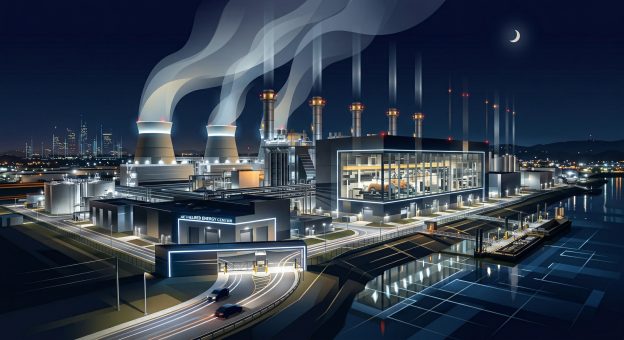
Bechtel and Kiewit have been selected as EPC contractors for a $33 billion power generation and AI infrastructure project in Southern Ohio, backed by Japanese institutional investors. First announced in October 2025, the project represents one of the largest private infrastructure investments in U.S. history and signals a major bet on the Midwest as a hub for AI-driven power demand. A consortium of 21 firms is involved in the development, which will deliver dispatchable generation capacity tied directly to hyperscale data center load.
The Players
Bechtel and Kiewit are leading engineering, procurement, and construction. Both firms bring deep experience in large-scale power and industrial projects — Bechtel with a global portfolio spanning LNG, nuclear, and combined-cycle gas, and Kiewit with a strong track record in U.S. utility-scale generation and transmission. The Japanese backing suggests involvement from trading houses, utilities, or sovereign-adjacent capital (Mitsubishi, Marubeni, JERA, or similar), though specific investors have not been disclosed. The 21-firm consortium indicates a complex structure involving equipment suppliers, offtakers, and potentially hyperscaler anchor tenants.
The Numbers
$33 billion in total project investment. While the exact generation capacity has not been specified, a project of this scale likely targets multiple gigawatts of dispatchable power — potentially 3–5 GW of combined-cycle gas turbines or a hybrid portfolio including gas, nuclear, or grid-connected storage. For context, a 2 GW combined-cycle facility typically costs $2–3 billion in capex; this project’s budget suggests either significantly larger capacity, integrated data center infrastructure, or both.
Ohio offers competitive advantages: access to Marcellus and Utica shale gas, existing transmission infrastructure, favorable interconnection timelines compared to PJM’s congested eastern zones, and a regulatory environment that has historically supported large industrial loads.
So What?
This is a market signal. Japanese capital doesn’t deploy $33 billion without locked-in offtake, firm interconnection, and confidence in long-term AI load growth. The involvement of Bechtel and Kiewit means this project is past the MOU stage — it’s moving toward FID and construction.
For power developers: The Midwest is no longer a secondary market. If you’re chasing hyperscaler load, Ohio, Indiana, and Michigan now compete directly with Virginia, Texas, and Arizona. Gas supply, transmission access, and speed to interconnection matter more than ever.
For investors: A $33B project backed by Japanese institutions sets a valuation benchmark for AI-linked generation assets. Expect more foreign capital targeting U.S. dispatchable power tied to data center offtake.
For utilities and ISOs: This scale of load addition will stress regional planning. PJM and MISO need to accelerate queue reform, or projects like this will increasingly pursue behind-the-meter or microgrid structures to bypass interconnection delays.
Action Items:
- Track Ohio’s interconnection queue for new gas generation applications in the 1–5 GW range
- Monitor Japanese trading house activity in U.S. power markets — this likely isn’t their only move
- Model Midwest site economics with firm gas transport and utility partnerships
- Watch for hyperscaler announcements tied to Ohio data center capacity in Q2 2026
Source: Construction Dive, March 26, 2026