Executive Summary
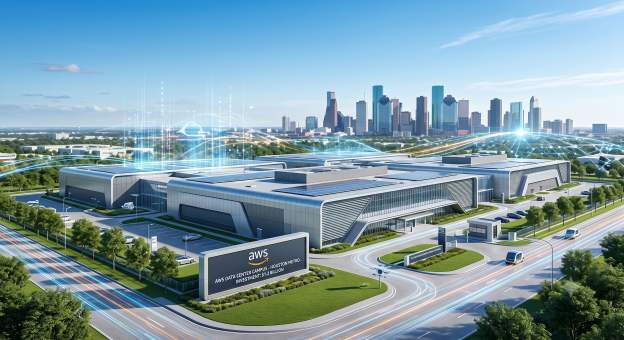
Amazon Web Services (AWS) has filed with the Texas Department of Licensing and Regulation for “Project Eagle,” a $1.2 billion, four-building data center campus in Boling, Wharton County, located southwest of Houston. Each building is identical in size (189,060 sq ft) and investment ($300 million), with construction starting August 1, 2026, and completion staggered between January and August 2027. The 2,700-acre site represents AWS’s continued expansion in Texas, following recent filings near Austin, San Antonio, Dallas, and a nuclear plant outside Fort Worth.
The Numbers
The total project cost is $1.2 billion ($300 million per building). Each building is 189,060 sq ft, implying a construction cost of roughly $1,586 per square foot—which is a tad high for standard data center construction (typically $800-1,200/sq ft), but may include site preparation, power infrastructure, and contingencies.
The land parcel is approximately 2,700 acres, meaning this campus could expand significantly beyond the initial four buildings—AWS is acquiring a massive footprint for future phases.
The timeline is aggressive: construction starts August 1, 2026, with first three buildings complete in just five months (January 2027). This is extremely fast for data center construction, suggesting AWS could be using pre-fabricated or modular designs, and has likely already secured power and permits.
So What?
This filing validates three critical trends, adding another datapoint to the Texas AI power rush:
First, rural Texas is the new data center frontier. Austin, Dallas, and Houston are the primary markets, but AWS is systematically buying up land in adjacent counties (Bastrop County near Austin, Wharton County near Houston, and near the Comanche nuclear plant outside Fort Worth).
Second, AWS is parallel-processing its Texas build-out. In just the last few months, AWS has filed for or acquired sites near Austin (1,300 acres in May), Fort Worth (nuclear plant campus), San Antonio (existing footprint), DeSoto (outside Dallas), and now Boling/Wharton County. This is not a single-campus strategy—AWS is building a network of data centers across Texas to serve different availability zones and customer needs.
Third, the premium for speed-to-power is now a premium for speed-to-permit. AWS is filing with TDLR for a four-building campus that starts construction in two months and finishes in five. This is only possible because they have pre-secured power, water, and zoning—or are confident they can. The bottleneck has shifted from construction timelines to utility interconnection and local permitting. AWS is moving at the speed of filing, not the speed of bureaucracy.
What Should You Do With This?
If you are a landowner or real estate developer in Wharton County: land values just increased substantially. AWS is buying at scale, but they may need additional land for future phases, substations, or workers. Consider joint ventures or selling options, not outright sales.
If you are a competitor (Google, Microsoft, Oracle): AWS is one of Texas’s most aggressive land buyer. Your response must be to secure your own rural sites with firm power commitments. The window for “cheap” rural Texas land with available interconnection is closing. Consider partnering with IPPs or landowners directly.
If you are a policymaker (Wharton County, Texas state government): this is an economic development windfall ($1.2B investment, construction jobs, eventual operations jobs). But it comes with power and water demands. Ensure AWS has firm commitments to mitigate strain on local resources. Consider tax abatements in exchange for community benefits (local hiring, road improvements, grid upgrades).
If you are an investor in data center REITs (Equinix, Digital Realty): AWS’s rural strategy is a competitive threat. They are building dedicated, single-tenant capacity at scale outside of primary metro markets. This could draw demand away from multi-tenant colocation in Houston and Austin. Monitor AWS’s leasing strategy—are these facilities for internal use only, or will they offer capacity to third parties?
If you are a hyperscaler’s real estate team: AWS’s filing pattern is a template. Secure land in secondary counties, file simultaneously for multiple buildings, use TDLR filings as public signaling, and move to construction within months. The race is no longer about who has the best technology—it’s about who can acquire and permit rural Texas land the fastest.
Source: Data Center Dynamics, July 8, 2026