Executive Summary
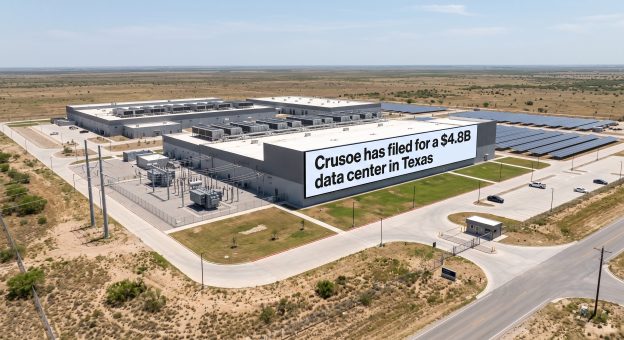
Crusoe Energy has filed plans for a $4.8 billion data center campus in Jayton, Texas, featuring two data center facilities likely connected to the company’s existing project in Childress. The development demonstrates Crusoe’s strategy of scaling modular, gas-powered compute infrastructure in rural markets with stranded energy resources.
The Players
Crusoe Energy, a Denver-based company specializing in data centers powered by stranded or flared natural gas, is the developer. Founded in 2018, Crusoe has built a business model around deploying modular data centers at oil and gas production sites, converting otherwise wasted energy into compute capacity for Bitcoin mining and, increasingly, AI workloads. The company has raised significant venture capital and has been expanding from small modular units to utility-scale campuses.
Jayton is located in Kent County in West Texas, a region with substantial oil and gas production and minimal existing data center infrastructure. The connection to Crusoe’s Childress project suggests a regional strategy to build interconnected capacity across West Texas. Known as Project Hyper, these additional buildings would bring the project’s total investment to $12 billion.
The Numbers
The $4.8 billion investment for two data center buildings implies substantial power generation and infrastructure. Construction will begin in 2027, and the buildings are expected to go online in May and July 2029.
So What: Strategic Implications
For power developers: Crusoe’s model demonstrates the value of integrated energy-compute projects. If you control stranded gas resources or can develop dedicated generation, you can monetize that energy at data center economics rather than wholesale power prices.
For Texas specifically: this continues the state’s emergence as a data center hub driven by deregulated power markets, available land, and proximity to energy resources. West Texas, historically an oil and gas region, is becoming a compute region.
The key question is whether Crusoe can secure long-term offtake agreements for this capacity at economics that justify the $4.8B investment. At this scale, they’re likely targeting hyperscaler or large enterprise customers, not just crypto mining.
Source: Data Center Dynamics, October 2, 2026