Executive Summary
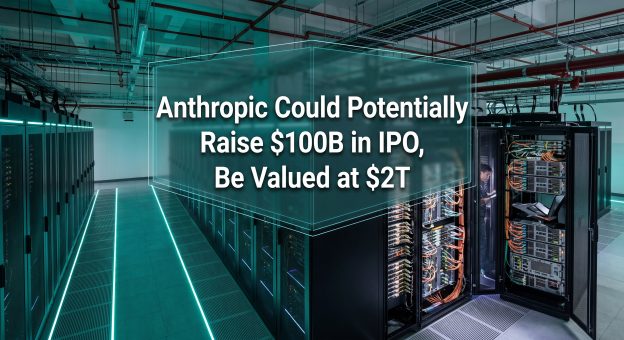
Anthropic, the AI research company behind the Claude family of large language models, is in discussions to pursue an initial public offering raise of $100 billion or more, according to reporting by The New York Times. This could value the company at $2 trillion. The potential IPO would rank among the largest technology offerings in history (possibly beating out SpaceX’s record-breaking IPO) and reflects the massive capital requirements needed to scale AI infrastructure, including data centers, semiconductor procurement, and energy resources. The move underscores how AI labs are transitioning from pure software companies into capital-intensive infrastructure operators.
The Players
Anthropic was founded in 2021 by former OpenAI executives including Dario and Daniela Amodei. Anthropic competes directly with OpenAI, Google DeepMind, and Meta in the frontier AI model space. The company has emphasized AI safety and constitutional AI principles in its positioning, but increasingly competes on infrastructure scale and model performance.
The Numbers
Anthropic’s revenue jumped over seven times to $65B annualized. This could support a potential $2 trillion IPO with $200 billion in revenue targeted by 2028.
The Times reporting notes that computing power—specifically access to data centers, chips, and energy—is now the primary constraint on AI model development and deployment. Industry estimates suggest training a next-generation frontier model requires 500-1,000 MW of dedicated compute capacity over 6-12 months, translating to hundreds of millions in energy costs alone.
So What: Strategic Implications
This IPO signals a fundamental shift in how AI companies are capitalized and operated:
First, AI labs are becoming infrastructure companies. The capital raise isn’t primarily for R&D or talent acquisition—it’s for physical assets. Anthropic needs long-term access to GPU clusters, which means either leasing massive data center footprints or building owned-and-operated facilities. Both paths require multi-billion dollar commitments and multi-year lead times.
Second, energy procurement is now a core competency. Training and inference workloads are energy-intensive and price-sensitive. Anthropic will need to secure firm power commitments, likely through long-term PPAs with renewable or gas-fired generation. The company may follow Microsoft’s playbook of co-locating compute with dedicated generation assets or even acquiring power infrastructure outright.
Third, the public markets are now pricing AI infrastructure risk. A $100B valuation assumes Anthropic can successfully navigate utility interconnection queues, semiconductor supply constraints, and energy market volatility. Public investors will demand transparency on power costs, data center utilization rates, and capital efficiency—metrics that were previously internal to hyperscalers.
Fourth, this raises the stakes for independent power producers and data center developers. If Anthropic and OpenAI are both raising $50-100B+ for infrastructure buildouts, they become anchor tenants capable of underwriting entire generation projects. Expect more direct negotiations between AI labs and IPPs, bypassing traditional utility procurement processes.
What to Do With This Information
For power developers: Anthropic’s capital raise creates a new class of creditworthy offtaker for long-term PPAs. If you’re developing gas, nuclear, or renewable projects in markets with available transmission capacity, reach out directly to AI labs’ infrastructure teams. They’re increasingly willing to sign 10-15 year power contracts to secure capacity.
For data center operators: The AI lab buildout wave is creating both opportunity and competition. Anthropic may lease capacity in the near term but will likely pursue owned infrastructure longer term. Position your facilities as bridge capacity while they build, and emphasize speed to energization.
For investors: A successful Anthropic IPO validates the thesis that AI infrastructure is a distinct asset class with utility-like capital intensity and long-term contracted revenue. Look for secondary opportunities in power generation, cooling infrastructure, and fiber connectivity serving AI workloads.
For utilities and grid operators: AI labs going public means their power demand forecasts will become public information, subject to investor scrutiny. Expect more formal load growth filings and interconnection requests as these companies formalize their infrastructure roadmaps.
Source: The New York Times, August 21, 2026.