Executive Summary
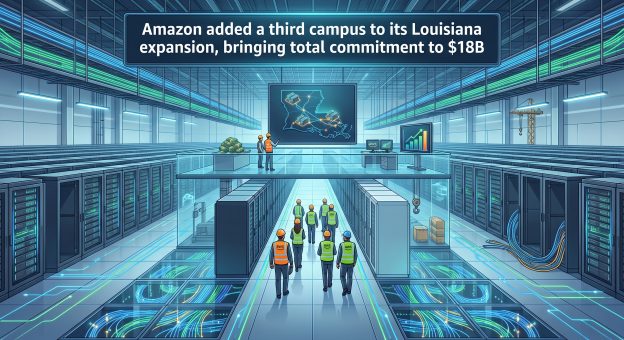
Amazon announced a third data center campus in Louisiana, bringing its total investment in the state to $18 billion. The expansion includes 750 full-time data center jobs and 2,500 additional positions across construction and operations. The announcement signals Louisiana’s emergence as a major hyperscaler destination and creates immediate demand for dispatchable generation capacity.
The Players
Amazon Web Services is the anchor tenant driving this buildout. Louisiana utilities will need to procure significant new generation capacity to serve this load. The state’s economic development apparatus has clearly been working to position Louisiana as a competitive alternative to saturated markets.
The Numbers
$18 billion total investment across three campuses represents one of the largest single-state hyperscaler commitments outside of traditional hubs. While Amazon hasn’t disclosed individual campus capacity, three campuses at this investment level likely represent 1.5-2 GW of total IT load when fully built out. At typical PUE ratios, that translates to 2-3 GW of utility-scale power demand.
The 750 direct jobs and 2,500 indirect positions indicate substantial construction activity over the next 3-5 years, suggesting a phased rollout rather than a single massive deployment.
So What — Actionable Intelligence
For power developers: Louisiana utilities will need to file for significant generation additions in their next integrated resource plans. This creates a 24-36 month window to secure PPAs for gas-fired generation that can meet Amazon’s reliability requirements. Behind-the-meter opportunities may also emerge if Amazon seeks to de-risk utility dependence.
For investors: Watch Entergy’s next earnings call for capex guidance related to data center load. The utility has historically been conservative on growth projections — a major revision would signal broader Gulf Coast momentum.
For site selectors: Louisiana’s success demonstrates that hyperscalers are willing to move to Tier 2 markets when power availability, cost, and speed-to-market align. Other states with stranded gas infrastructure and available transmission — think Mississippi, Alabama, West Virginia — should take note.
The Gulf Coast is no longer a backup plan. It’s becoming primary infrastructure.
Source: TradingView/Benzinga, August 19, 2026