Executive Summary
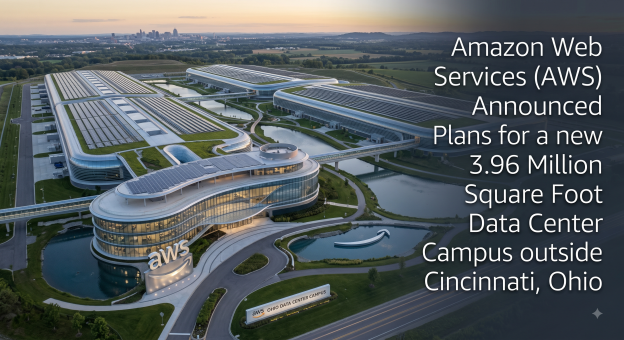
Amazon has announced plans for an 18-building, 3.96 million square foot data center campus outside Cincinnati, Ohio, near Trenton. The development signals continued geographic diversification of AI and cloud infrastructure into the Midwest.
The Players
Amazon (AWS) is the developer and operator. The campus will likely be served by Duke Energy Ohio, based on its proximity to a Duke Energy substation and the utility’s 692MW gas-powered Madison Power plant.
The Numbers
- 3.96 million square feet: Total campus footprint
- 18 buildings: Suggests phased development over multiple years
- Location: Trenton, Ohio (Butler County), within PJM footprint
No investment figure, timeline, or power capacity commitment has been disclosed. However, a campus of this scale typically requires $2–4 billion in total capital expenditure over 5–7 years.
So What?
This is a Midwest power play. Cincinnati isn’t traditionally considered a Tier 1 data center market, but it offers competitive electricity rates, fiber connectivity, and access to both PJM and MISO markets. Amazon is betting that power availability and cost will matter more than proximity to legacy hubs like Northern Virginia or Silicon Valley.
For utilities, this campus will drive incremental load growth that requires new generation and transmission investment. Utilities will likely file integrated resource plans (IRPs) that include new gas-fired generation, grid-scale storage, or long-term PPAs to serve this load. Watch for regulatory filings in Q4 2026 or Q1 2027.
For power developers, this is a clear demand signal. If you have dispatchable generation projects in PJM or MISO — especially gas turbines or behind-the-meter solutions — this campus creates a multi-hundred-megawatt offtake opportunity. Amazon has historically been willing to sign long-term PPAs for dedicated capacity, particularly when it de-risks their expansion timelines.
For the broader market, this announcement confirms that hyperscalers are no longer constrained to traditional data center markets. They’re going where the power is available, which means secondary markets with strong utility relationships and flexible interconnection processes are now in play.
What to Do
If you’re a developer with projects in PJM or MISO, reach out to Amazon’s energy procurement team and local utilities now. If you’re a utility, start modeling the grid impact and filing for cost recovery. If you’re an investor, watch for follow-on announcements around power partnerships, co-location deals, or behind-the-meter generation.
Source: Data Center Dynamics, August 13, 2026