Executive Summary
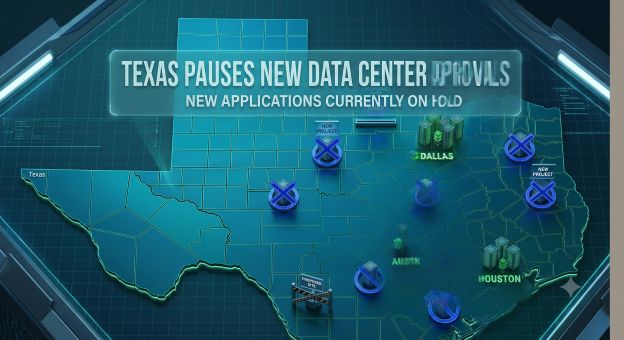
Texas Governor Greg Abbott has ordered a temporary halt on new data center approvals, mandating a comprehensive review of grid and water resource impacts. The move comes as ERCOT’s interconnection queue has ballooned to over 474 gigawatts of demand across more than 1,800 development projects — more than triple the grid’s current installed capacity of approximately 150 GW. This represents the first major state-level regulatory intervention specifically targeting data center load growth.
The Players
Governor Abbott’s office is leading the review in coordination with ERCOT (Electric Reliability Council of Texas), the state’s grid operator. The pause affects all pending data center applications across Texas, impacting hyperscalers, colocation providers, and private data center developers who have flocked to the state for its deregulated power markets, favorable tax treatment, and available land. Texas has been a primary expansion market for Amazon, Microsoft, Google, Meta, and numerous wholesale data center operators.
The Numbers
ERCOT is currently monitoring 1,800+ development projects representing 474 GW of potential demand. To put this in perspective, if even 30% of that queue materializes, Texas would need to add roughly 140 GW of new generation capacity — nearly doubling the entire grid. The state’s current summer peak demand sits around 85 GW, meaning the data center pipeline alone could represent 5-6x current peak load growth.
The review will assess both electric grid capacity and water resources, the latter being particularly critical given Texas’s ongoing drought management challenges and the fact that data centers require substantial water for cooling systems.
So What — Actionable Intelligence
This is a watershed moment for data center power procurement strategy. Three immediate implications:
First, behind-the-meter generation just became non-negotiable for large data center projects in Texas. Developers who can bring their own dispatchable power — whether through gas turbines, nuclear, or hybrid solutions — will move to the front of the line when approvals resume. Projects relying solely on grid power will face extended timelines and potentially unfavorable interconnection terms.
Second, this creates a massive opportunity for independent power producers and generation developers. If Texas is serious about accommodating even a fraction of this load growth, the state needs 200-300 GW of new dispatchable generation over the next decade. That’s $200-400 billion in generation investment at current costs. Gas turbine orders, nuclear development, and grid-scale storage projects tied to specific data center offtake agreements will be the winners.
Third, expect other states to follow Texas’s lead. If the most business-friendly energy market in the US is pumping the brakes, regulators in Virginia, Georgia, Ohio, and other data center hotspots are watching closely. Developers need to show up with credible answers on generation, transmission upgrades, and resource consumption — or expect delays.
For power developers and investors: Texas just validated the thesis that AI load growth requires a fundamental rebuild of generation infrastructure. The projects that get built will be the ones that solve the power problem, not the ones that assume someone else will.
Source: Yahoo News / Texas Tribune, August 8, 2026