Executive Summary
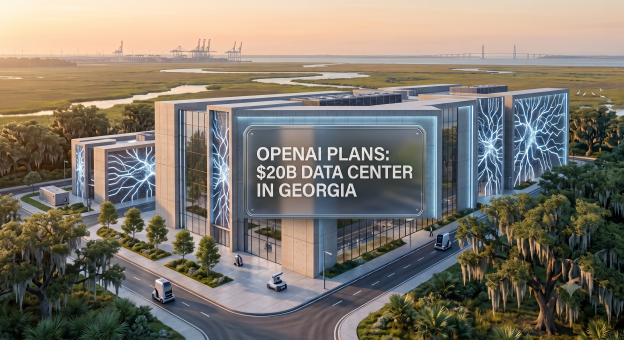
OpenAI plans to spend $20 billion to develop a data center facility near Savannah, Georgia, representing the state’s first coastal data center deployment. The campus will be located in rural Effingham County, about a 30-minute drive from Savannah. The project signals a geographic expansion beyond traditional data center hubs and will create significant new baseload power demand in a region with limited existing digital infrastructure.
The Numbers
$20 billion is the headline figure. Assuming standard hyperscale data center construction costs of $6-8 million per MW for AI-optimized facilities, this investment likely supports 2,000-3,000 MW of IT load. That translates to 500-750 MW of continuous power demand at typical data center utilization rates, with peak demand potentially exceeding 1 GW.
For comparison, Georgia Power’s most recent load forecast projected 1.5 GW of new data center demand across the entire state through 2030. This single project could represent half that total.
So What — Actionable Intelligence
For power developers: OpenAI has already secured power commitments, or Georgia Power has made internal capacity allocations that aren’t yet public. The coastal Savannah area is not historically a generation hub — most of Georgia Power’s baseload capacity sits inland or near Atlanta. This means either (a) new generation is coming, (b) transmission upgrades will enable power delivery from existing plants, or (c) OpenAI is bringing behind-the-meter generation.
Georgia Power’s next Integrated Resource Plan (IRP) filing will be critical. If this load is in the queue, expect 500+ MW of new gas turbine capacity or nuclear uprates to be proposed. Southern Company has been vocal about supporting data center growth with dispatchable generation, and this project will test that commitment.
For investors: Coastal Georgia is now a live market. Land acquisition, substation capacity, and fiber routes near Savannah will see immediate pressure. If OpenAI is building here, other hyperscalers will evaluate the region — but only if power is available. The bottleneck will be generation and transmission, not land or labor.
Source: Atlanta Journal-Constitution via LinkedIn, July 24, 2026.