Executive Summary
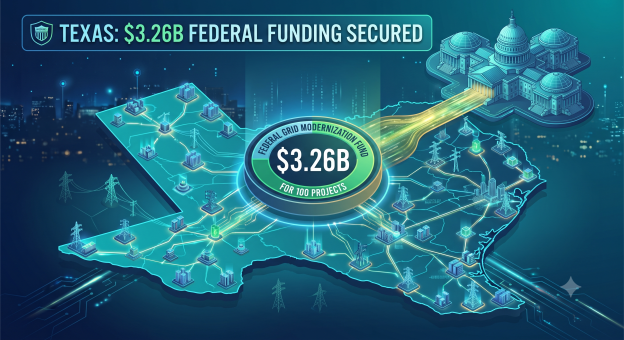
Texas has secured a $3.26 billion federal loan to fund 100 grid infrastructure projects. The financing comes as Texas operates the second-largest data center market nationally behind Northern Virginia, with grid reliability emerging as a critical constraint on further expansion. The loan signals federal recognition that AI-driven load growth requires proactive transmission and distribution investment, not just generation capacity.
The Players
The loan flows through the Office of Energy Dominance Financing under President Trump’s executive order, “Unleashing American Energy.” It is designed to support grid modernization and reliability. The timing aligns with ERCOT’s ongoing capacity challenges and the concentration of hyperscaler activity in the state, including major deployments from Microsoft, Meta, and Oracle.
The Numbers
$3.26 billion in federal loan commitments, allocated across 100 projects. The average allocation of ~$32.6 million per project suggests a mix of substation upgrades, transformer capacity additions, and distribution system hardening. The funding will help cover roughly 2,800 miles of new and upgraded transmission infrastructure. The capital is explicitly tied to supporting data center load growth and grid reliability in a market already under strain from AI infrastructure demand.
So What — Actionable Analysis
This changes the calculus for power developers and investors in ERCOT. Federal grid financing removes a major uncertainty: whether transmission and distribution infrastructure would keep pace with generation and load growth. For developers deploying AI-ready dispatchable generation, this means:
- Interconnection timelines improve. If federal dollars fund substation and transformer upgrades in data center corridors, queue positions get less risky.
- Behind-the-meter and co-location projects become more viable. Grid upgrades reduce the need for fully islanded solutions, opening up hybrid models.
- Merchant generation economics strengthen. Broad grid hardening supports higher reliability and potentially tighter capacity markets, improving revenue certainty.
Developers should track how this capital gets allocated geographically. If it concentrates in known hyperscaler corridors (Dallas-Fort Worth, Austin, San Antonio), co-location opportunities accelerate. If it’s distributed statewide, merchant generation across ERCOT benefits.
For investors: Federal grid financing de-risks the demand side of the equation. The bottleneck shifts back to generation capacity and fuel supply, where dispatchable assets — gas turbines, nuclear, fuel cells — capture the value.
Source: Yahoo Finance, July 17, 2026