Executive Summary
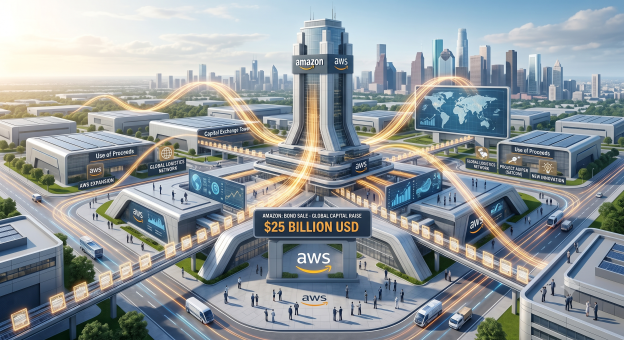
Amazon is raising at least $25 billion in a bond sale and has announced it will not issue additional debt in 2026. The capital raise is explicitly intended to fund the company’s aggressive AI infrastructure and data center expansion plans. This underscores how hyperscalers are leveraging public debt markets to finance multi-year capital expenditure programs tied to artificial intelligence and cloud computing growth.
The Players
AWS is the largest cloud infrastructure provider globally and is racing to build out AI-optimized data centers to support demand from enterprise customers and internal AI initiatives.
The Numbers
$25 billion minimum bond issuance, with Amazon stating it will not return to debt markets for the remainder of 2026. The bonds are expected to carry investment-grade ratings, reflecting Amazon’s strong balance sheet and cash flow generation, with proceeds earmarked for capital expenditures including data center construction, power infrastructure, and AI hardware procurement.
So What?
This deal is a clear signal that hyperscalers are committing to multi-year, capital-intensive infrastructure programs and are willing to lever their balance sheets to maintain competitive positioning in AI. Amazon’s decision to close its 2026 debt issuance window after this raise indicates the company has secured sufficient capital to execute its near-term buildout plans, which likely include signing long-term power purchase agreements, funding behind-the-meter generation projects, and securing interconnection capacity.
For power developers and energy investors, this matters because hyperscaler debt raises translate directly into downstream capital deployment for power infrastructure. Amazon’s $25B gives it the financial flexibility to sign 10–15 year PPAs, commit to co-development of dispatchable generation assets, and lock in firm capacity ahead of competitors. The bond market is effectively underwriting the AI data center boom—investors are lending to Amazon at favorable rates because they believe in the durability of AI-driven load growth.
The broader trend is significant: hyperscalers are moving from pay-as-you-go utility relationships to long-term, structured power procurement strategies. They’re willing to take on balance sheet risk to secure energy supply, which creates opportunities for independent power producers, gas turbine OEMs, and nuclear developers to negotiate long-duration offtake agreements with creditworthy counterparties.
What to Do
If you’re developing dispatchable generation or have shovel-ready sites near hyperscaler hubs (Northern Virginia, Ohio, Texas, Oregon), this is your financing window. Amazon’s capital raise signals it’s ready to move from LOIs to binding agreements. For investors, track AWS’s capex deployment over the next 12–18 months—this $25B will flow into turbine orders, substation upgrades, and interconnection deposits. For utilities and ISOs, expect Amazon to accelerate interconnection requests and push for expedited queue processing. The hyperscalers have the capital; now it’s a race for power and land.
Source: CNBC, July 8, 2026.