Executive Summary
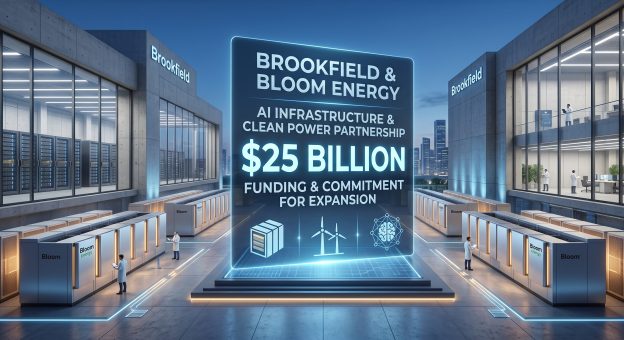
Brookfield and Bloom Energy expanded their partnership to $25 billion, significantly scaling their joint effort to deploy solid oxide fuel cells for AI data center infrastructure globally. The deal builds on an earlier collaboration and represents a large capital commitment to behind-the-meter generation in the data center sector. The partnership targets hyperscalers and colocation operators facing grid interconnection delays and power availability constraints.
The Players
Brookfield is a global alternative asset manager with over $850 billion in AUM, including significant exposure to renewable energy, utilities, and digital infrastructure. Bloom Energy is a leading fuel cell manufacturer specializing in solid oxide technology that can run on natural gas, biogas, or hydrogen. The partnership leverages Brookfield’s capital and project development capabilities with Bloom’s technology and manufacturing scale.
The Numbers
The $25 billion commitment is a substantial increase from the initial partnership size, which was valued at $5 billion. Assuming Bloom’s fuel cells cost approximately $4–5 million per MW installed, this could support 5–6 GW of capacity—enough to power dozens of large-scale data center campuses.
So What?
This deal is a direct response to the grid interconnection crisis. Data center developers are facing 5–7 year queue times in PJM, MISO, and ERCOT. Fuel cells offer a faster path: they’re modular, can be deployed in 12–18 months, and don’t require transmission upgrades. For hyperscalers building AI training clusters, speed matters more than cost.
But there’s a trade-off. Fuel cells are more expensive per MW than combined-cycle gas turbines and less efficient at scale. They make sense for 50–200 MW behind-the-meter applications but struggle to compete with utility-scale generation on economics alone. Brookfield is betting that the premium for speed and reliability is worth it—and that fuel cells become the bridge solution until the grid catches up.
What to Do
If you’re a gas turbine developer, focus on speed and modularity—your competitive advantage is cost and efficiency, but only if you can compress timelines. If you’re a fuel supplier, reach out to Brookfield and Bloom now to discuss long-term gas supply agreements. If you’re a data center operator, model the economics of fuel cells versus waiting for grid power—the answer will depend on your cost of capital and time to revenue.
Source: Yahoo Finance, June 30, 2026