Executive Summary
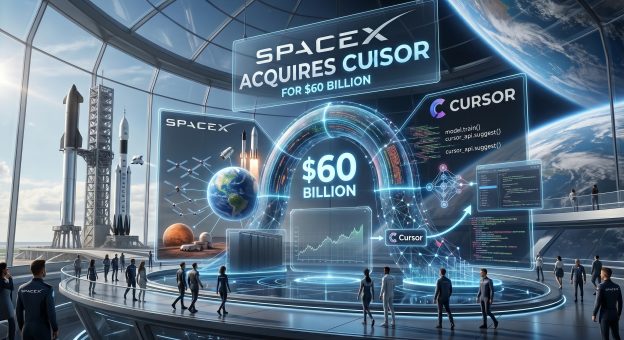
SpaceX, just four days after completing the largest initial public offering in history, is acquiring AI start-up Cursor for $60 billion in an all-stock deal. The transaction exercises an option struck in April 2026, giving SpaceX control of Cursor’s AI-powered coding tools. The acquisition is the latest step in Elon Musk’s consolidation of his AI empire, following the merger of SpaceX with xAI in February and plans for orbital data centers and a $55 billion AI chip factory in Texas.
The Pkayers
SpaceX is now a publicly-traded company valued at over $2.6 trillion. Its IPO performance made Elon Musk the world’s first trillionaire. While historically a rocket and satellite internet company, SpaceX has pivoted aggressively toward AI infrastructure—including orbital data centers, chip manufacturing, and now AI software.
Cursor (parent company Anysphere) was founded in 2022 and quickly became a leader in AI-powered coding tools, backed by Thrive Capital, Andreessen Horowitz, and Accel. Despite billions in funding, Cursor was “bottlenecked” by lack of computing power for training its AI models—a problem SpaceX’s xAI infrastructure can now solve.
xAI, Musk’s AI startup behind the Grok chatbot, was merged into SpaceX in February. The combined entity has struggled to compete with OpenAI, Anthropic, and Google, experiencing high-profile departures and admitting to underutilizing its two massive Tennessee data centers. However, it has signed major compute deals with Google and Anthropic, generating billions monthly.
The Numbers
SpaceX’s stock has risen more than 50% from its IPO offer price, making its currency exceptionally valuable for acquisitions.
The deal structure is critical: SpaceX had an option to acquire Cursor, exercised post-IPO. This allowed Cursor to secure a guaranteed exit while giving SpaceX flexibility to pay with newly appreciated stock.
SpaceX reported a $4.9 billion loss last year (versus $791M profit in 2024) due to AI spending. However, its compute deals with Google and Anthropic generate “billions a month,” creating a circular economy: hyperscalers pay SpaceX for compute; SpaceX uses that revenue to fund AI chip factories and orbital data centers.
So What?
This deal validates four critical trends, now intersecting at the highest level of corporate finance and space technology:
First, AI is the new space race. SpaceX was already the dominant launch provider. Now it is becoming the dominant AI infrastructure provider—from orbit. Musk’s logic: orbital data centers have access to unlimited solar power and cooling, eliminating terrestrial energy constraints.
Second, vertical integration is now total. SpaceX builds rockets (transport), Starlink (connectivity), xAI (models), Cursor (applications), and soon chips (semiconductors). No other AI company owns its launch vehicles; no other launch provider owns its AI models. This is the most vertically integrated AI company ever.
Third, coding tools are a strategic bottleneck. Cursor is not just another AI model; it is a developer productivity platform. By owning the tools that write code, SpaceX can accelerate its own software development for rockets, satellites, data centers, and chips. This is why Anthropic and OpenAI have also invested heavily in coding capabilities.
Fourth, Musk is consolidating his empire. xAI merged into SpaceX, then SpaceX buys Cursor. Tesla, X (Twitter), and Neuralink remain separate, but the pattern is clear: Musk is creating a single, massive AI-industrial complex, funded by public markets.
What Should You Do With This?
If you are an AI startup: your acquirers are no longer just Google, Microsoft, or Amazon. SpaceX, Tesla, and other “non-tech” industrial giants with inflated stock are now buyers. Structure your next funding round with an acquisition option or warrant, as Cursor did. The premium for being a strategic asset to a public company can far exceed a traditional M&A process.
If you are an investor in SpaceX (post-IPO):*you are now betting on AI, not just rockets. Monitor: (1) whether Cursor’s tools can be integrated without losing key talent, (2) whether the Google/Anthropic compute deals are profitable or subsidized, and (3) whether orbital data centers are technologically feasible this decade.
If you are a competitor (OpenAI, Anthropic, Google): SpaceX just became a direct threat. It has launch capabilities you lack, a captive market (Starlink), and a trillionaire CEO. Your response should be: (1) secure your own launch partners, (2) invest in coding tools defensively, and (3) consider public listings to get your own acquisition currency.
If you are a power developer: SpaceX’s orbital data center concept is a long-term threat. If space-based solar power becomes real, terrestrial energy constraints (your core value proposition) disappear. But for the next decade, SpaceX still needs ground-based power for its Texas chip factory and Tennessee data centers—partner now, before they go fully orbital.
If you are a policymaker: SpaceX is now a $2.6T company with interests in launch, satellites, AI, chips, and space-based power. Antitrust scrutiny is inevitable. But so is national security interest—the US cannot afford to let China dominate either space or AI. Your framework should treat this as a critical infrastructure asset, not just a corporate merger.
Source: The New York Times, June 16, 2026